SpeaD 1.0 · Voice Coil
Voice Coil Design
A voice coil solver across 47 winding architectures, with an embedded wire and former database, turn-by-turn winding layouts and RFQ-format manufacturing drawings.
A true design solver
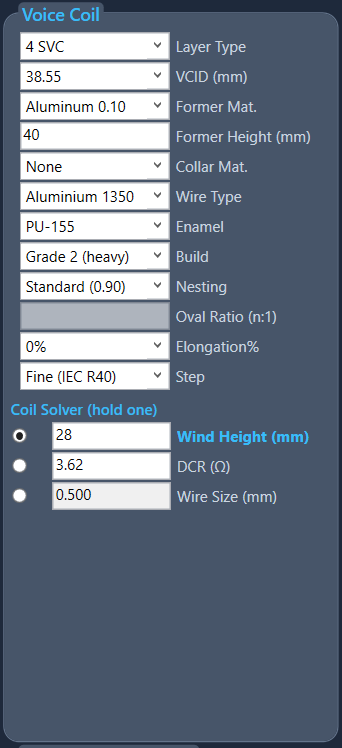
The Voice Coil panel takes a former, a conductor and a winding architecture and produces a fully specified coil: its outside diameter, turn count, wire length, mass and DC resistance. In the Solve block you hold either the winding height or the DCR, and SpeaD solves the wire size — and, with DCR held, the winding height as well. The solved diameter snaps to a real, purchasable size: Continuous, Standard (IEC R20) or Fine (IEC R40).
The solve re-runs as soon as you press Enter or Tab. Turn count flows straight to the motor, so a coil change updates BL immediately.
An embedded wire and former database
Twelve conductors, each with its own resistivity and density — copper grades, silver, gold, Aluminium 1350 and 6101, and three copper-clad aluminium grades. Six enamel classes from PU-155 to PI-240, three build grades, and nesting factors for precision, standard, adhesive and flat-wire winding. Thirty-four former materials in ten families — aluminium (anodised and bare), Kapton, Kapton MTB, Nomex, glass fibre, PEEK, PEI, nylon and titanium — plus collar materials, each as a material at a specific thickness.
An Elongation % input accounts for wire stretch during winding, which raises DCR and slightly reduces diameter, so the prediction matches the figure your winder works to and yields highly accurate predictions.
47 winding architectures
- SVC — one conductor in 1 to 8 layers.
- DVC, TVC, QVC — two, three or four independent coils on one former.
- Inside/outside (ISV) — wire wound on both faces of the former wall, for roughly double the active conductor in the gap at the same coil height.
- Multifilar — bifilar, trifilar and quadfilar, 2 to 8 layers.
- Edge-wound and flat wire — rectangular wire for a high fill factor.
- Stepped — the layer count varies along the height (4/2/4, 2/4/2 and more) to shape the BL(x) curve.
Which types appear in the dropdown is configurable in the Data Manager, so a factory can show only the windings its line builds.
Winding layouts
The Winding Layout window draws a half section through the coil, every turn at its true wire diameter, with layer labels, winding direction and lead ends — and cross-checks the layout against the solve.

Voice Coil tab and manufacturing drawing
The Voice Coil tab turns the designed coil into a manufacturing document. Document Info fills the title block; Drawing Inputs specify former bottom treatment, vent holes, lead-out style and length, reinforcement, marking colour, winding position and DCR and dimensional tolerances. Create Drawing produces an RFQ-format specification sheet with a lettered assembly drawing, ready to export as PDF, print or copy — in English or bilingual English and Chinese.
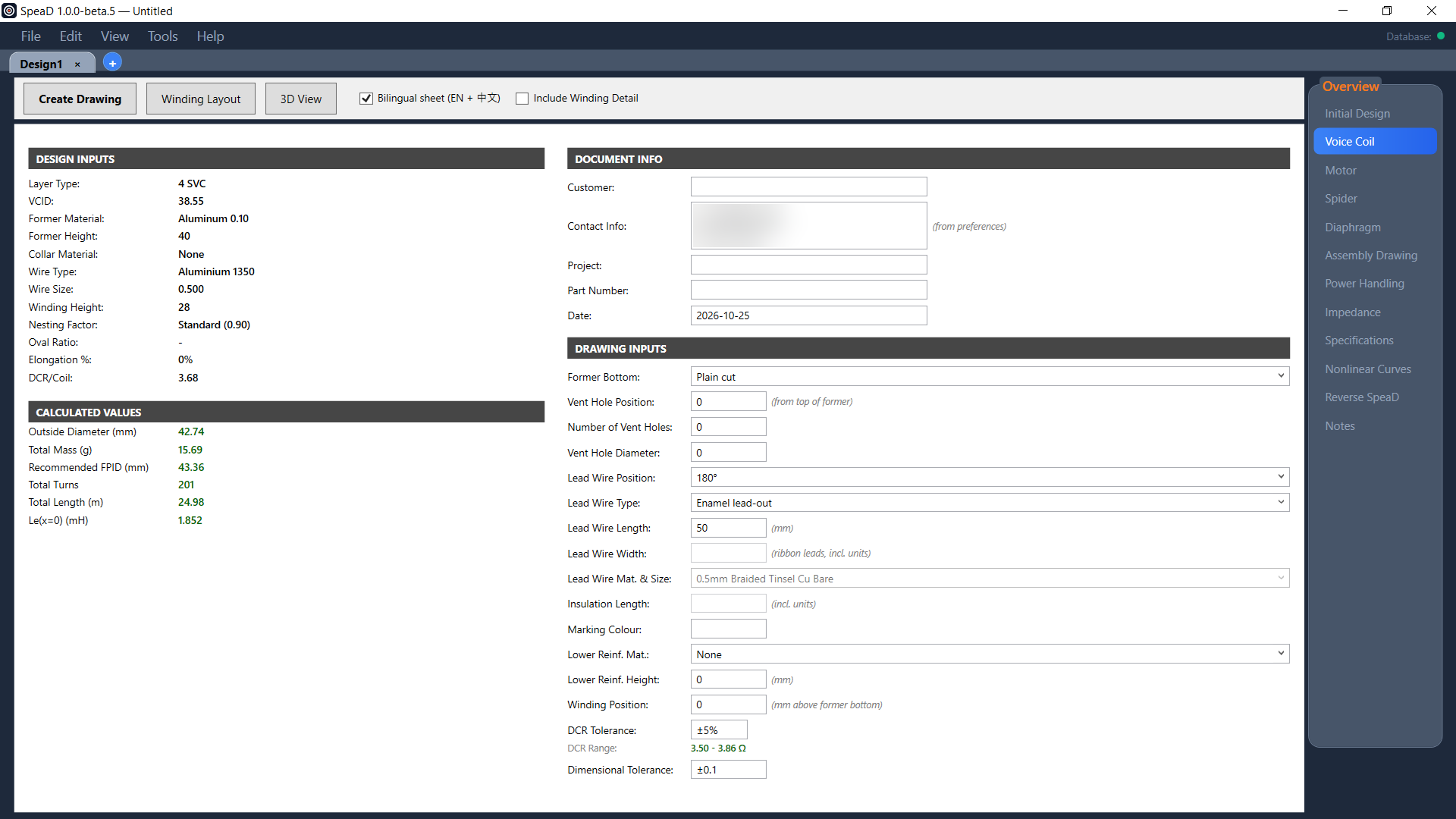
A 3D View button opens a rotatable render of the coil.
Read the Voice Coil chapter of the SpeaD Owner’s Manual for every control on the page.