SpeaD 2026 · Reverse SpeaD
Reverse SpeaD
Driver Synthesis from System Targets
Conventional design starts with a driver and works forward. Reverse SpeaD inverts the process — specify the system performance you need, and SpeaD synthesizes the ideal driver.
Inverting the design problem
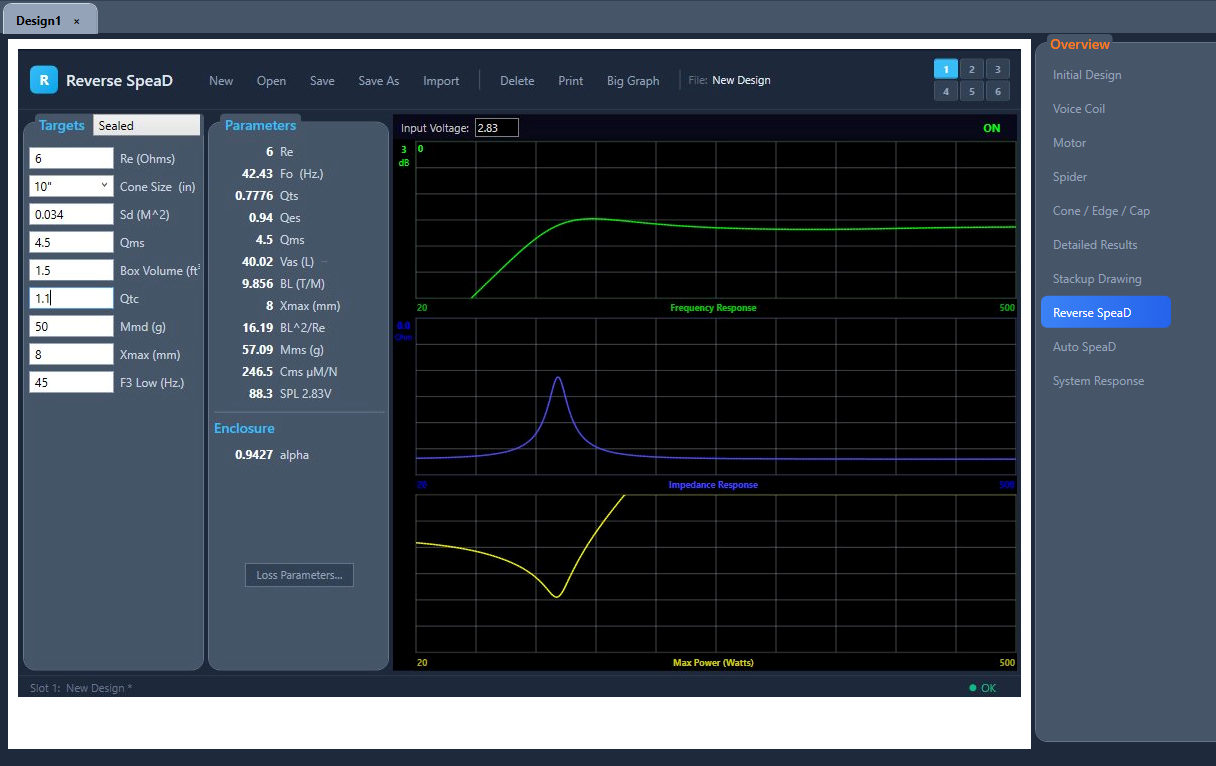
One of SpeaD's most distinctive and practically useful features is Reverse SpeaD. Conventional loudspeaker design starts with a driver and works forward to predict system performance. Reverse SpeaD inverts the process: you specify the system performance you need — F3 frequency, box type and volume, Qtc, and the other system-specific input parameters — and the software synthesizes the ideal driver Thiele-Small parameters required to meet those targets.
Nine supported enclosure types
Nine enclosure types are supported: infinite baffle; sealed; vented with four alignments (B4, C4, QB3, SBB4); single-reflex bandpass; dual-reflex bandpass; sealed with active equalization; high-BL with filters and EQ; optimized current bandwidth with filters and EQ; transmission line; and tapped horn.
For each enclosure type, Reverse SpeaD outputs the full Thiele-Small parameter set including Re, Fo, Qts, Qes, Qms, Vas, BL, Xmax, power handling, Mms, Cms, and 2.83V sensitivity.
Simultaneous response analysis
Response graphs display simultaneously: frequency response, impedance response, maximum SPL, group delay, and transfer function / current (for active systems). Six independent design slots allow side-by-side comparison of designs, making it straightforward to evaluate trade-offs.